


The pre-IPO secondaries market is one of the best-kept secrets in global finance. It’s also one of the fastest-growing. Here’s what it is, why it exists, and why the moment to pay attention is right now.
Most investors discover a great company the same way: it goes public, the financial press covers the IPO, and they log into their brokerage account and buy shares. That process feels normal because it’s the only one most people have ever had access to.
To be clear — public markets have made investors very wealthy. Nvidia is perhaps the most vivid recent example: a publicly listed company that delivered returns of over 2,000% in the five years to 2025 for investors who had the conviction to hold. The public market is not a bad place to invest. For most people, it remains the right place to start.
But here’s what’s worth understanding. By the time a company lists on a public exchange, it has already been privately owned — and growing — for years. Sometimes a decade or more. The employees, early investors, and venture funds who backed it at the start have already watched it go from a small startup to a business generating hundreds of millions in revenue. They captured that entire journey. The public investor arrives later in the story.
This isn’t a flaw in the system. It’s simply how private markets work — and for most of financial history, accessing those earlier stages required relationships, legal infrastructure, and operational bandwidth that were simply out of reach for most investors.
That market is called the pre-IPO secondaries market. It runs parallel to the public markets most people know — quieter, less visible, and until recently, effectively closed to South African investors. That’s changed, and the implications are worth understanding.
Why This Market Exists at All
To understand pre-IPO secondaries, you first need to understand what broke about the IPO.
Twenty-five years ago, a company like Google went public relatively early in its growth curve. Public market investors got to participate in a substantial portion of the value creation. The IPO was a beginning, not a finish line.
That model is gone.
Today, the most valuable technology companies in the world routinely stay private for a decade or more — sometimes far longer. OpenAI, valued at approximately $300 billion, has never traded on a public exchange. SpaceX has been building for over two decades and remains private. Stripe, worth north of $90 billion, has been “about to IPO” for the better part of five years.
This isn’t an accident. It’s a deliberate strategic choice. Private companies avoid quarterly earnings pressure, activist shareholders, and the disclosure obligations that force public companies to play short-term games. Unshackled from those constraints, they move faster, make bolder decisions, and compound value in ways that public-market governance simply doesn’t allow.
For their early investors, this is wonderful. For everyone else, it creates a structural problem: by the time a company finally IPOs, the majority of the transformational growth has already been captured. The public market investor buys in at maximum visibility — when the narrative is fully priced and the runway to extraordinary returns has already been run.
Pre-IPO secondaries exist to solve that problem.
The Secondary Transaction: Simple Concept, Enormous Market
Here’s how it works.
A company grows. It stays private. Time passes. And along the way, the people who got in early — founding engineers, seed investors, early-stage venture funds — they develop needs that the company’s success alone can’t meet. A founding engineer wants to buy a house. A VC fund is approaching the end of its ten-year life and needs to return capital to its LPs. An early executive has moved on and wants to convert paper wealth into something real.
They can’t sell on a stock exchange. So they sell privately — through what is known as a secondary transaction. A buyer steps in, acquires their stake and their economic rights, and assumes their exposure to the company’s future.
That transaction is the pre-IPO secondary market. And it has grown into something remarkable.
According to Bain & Company, the global secondary market expanded from $273 billion in 2019 to $601 billion in 2024 — a 120% increase in five years. In the first half of 2025 alone, secondary transaction volume hit $103 billion, a 51% jump from the same period the year before. The full-year 2025 market is estimated to have exceeded $210 billion.
These are not cyclical numbers. They reflect a structural shift in how private capital moves — one that shows every sign of accelerating as more companies choose to stay private longer, and more early holders need liquidity.
The reason this market doesn’t make the front page is by design. Private markets have no disclosure obligations, no analyst coverage, no quarterly earnings circus. Information flows only between qualified counterparties, and that opacity — far from being a flaw — is the feature that preserves the return premium. A market that anyone can read about is a market that anyone can crowd into.
The Investment Case: What You’re Actually Buying
A secondary transaction is not a punt on an unproven idea. It is an acquisition of a proven business at a private-market price, before the public premium arrives.
The distinction matters enormously. Unlike seed or Series A investments — where you’re essentially betting on whether a company can survive — late-stage pre-IPO secondaries target businesses that have already navigated the most dangerous phases of their existence. The product works. The revenue is real. The market position is established. The remaining question isn’t whether the company will survive. It’s about timing, valuation, and how much of the upside still lies ahead of you.
There are other structural advantages that don’t get discussed enough.
In slower exit environments, sellers — employees who need liquidity, funds facing duration pressure, LPs rebalancing portfolios — may accept meaningful discounts to the last primary round valuation. For buyers, this creates an opportunity to acquire high-quality exposure at prices that already build in a margin of safety. You’re not bidding at the peak; you’re buying from someone who simply needs out.
And because private holdings don’t reprice with daily market volatility, they offer genuine portfolio diversification. In a world where public equities move in lockstep at the first sign of macro noise, a measured allocation to late-stage private companies provides exposure that is structurally uncorrelated with public equity beta — at least in the short term.
The Companies That Are Defining What Comes Next
None of this would matter if the underlying companies weren’t extraordinary. But right now, the private market is home to a cohort of businesses that represent something genuinely rare: the foundational layer of the next technological era.
We’ve been through industrial revolutions before. Steam engines, electrification, the internet — each one followed a similar pattern. A transformative new technology improved productivity, created enormous wealth, and eventually reached a plateau as the binding constraints of labour and capital reasserted themselves.
AI is structurally different. It doesn’t just improve productivity. It removes constraints on labour itself. A software engineer trains a model that does the work of ten engineers. Then a hundred. Then a thousand. The binding input shifts from human hours (which are finite and expensive) to compute power, which has been growing exponentially for sixty years and shows no signs of slowing.
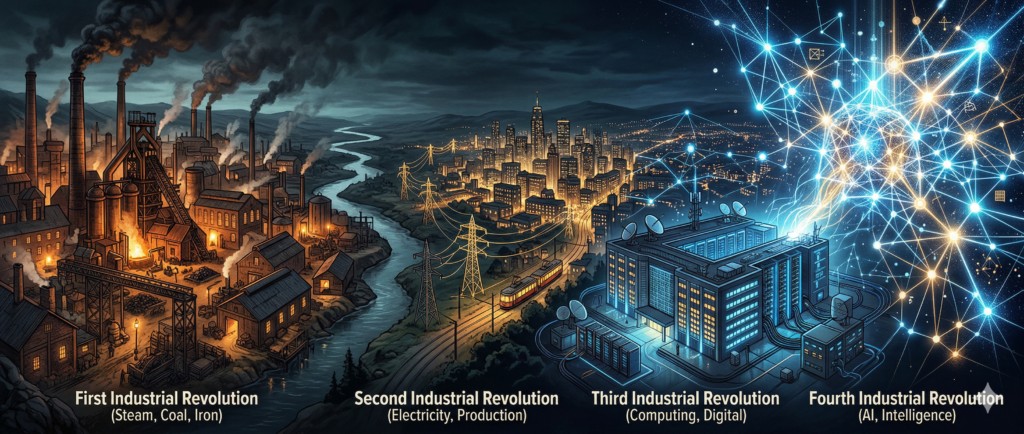
This is why the growth rates look like nothing we’ve seen before. OpenAI went from zero to a $300 billion valuation faster than Facebook reached $50 billion. Anthropic hit $60 billion in under three years. These aren’t aberrations. They are what happens when a company’s output is no longer constrained by headcount.
The companies at the centre of this shift map onto specific layers of a new value stack.
At the hardware layer, the silicon that makes AI possible at scale is being redesigned from the ground up. Tenstorrent — led by Jim Keller, the architect behind Apple Silicon, AMD’s Zen chips, and Tesla’s Autopilot hardware — is building next-generation AI processors on open-source RISC-V architecture. Backed by Hyundai Motor Group and others, Tenstorrent is going after Nvidia’s $4.5 trillion AI chip market with a more affordable, more efficient approach. Groq is engineering specialised language processing units for the fastest inference in the industry. These are the companies that control the compute substrate — the foundation everything else runs on.
At the intelligence layer, OpenAI, Anthropic, and xAI are building the foundation models that replace human hours with model hours. Every improvement in these systems multiplies the amount of work that can be performed without hiring a single person. These aren’t software companies in the traditional sense. They are, arguably, the most significant infrastructure projects in human history.
At the application layer, Databricks manages the data infrastructure that thousands of enterprises cannot function without. Stripe and Revolut are reinventing global financial infrastructure. Anduril is applying AI to defence and national security. SpaceX is operating global satellite internet while simultaneously holding over 70% of the commercial launch market. Canva has made design infrastructure accessible to hundreds of millions of people worldwide.
None of these companies trade on any exchange. Most of the investing public will encounter them for the first time on IPO day — when the majority of the extraordinary growth has already been captured.
The Structure That Makes Access Possible: The SPV
Understanding the opportunity is the first step. Understanding how you actually get into it is equally important — because without the right legal structure, the opportunity simply doesn’t reach you.
The dominant vehicle for pre-IPO secondary investing is the Special Purpose Vehicle, or SPV.
Here’s why it matters. Private companies routinely include transfer restrictions (Right of First Refusal clauses, consent requirements, minimum allocation thresholds) that make it practically impossible for individual investors to acquire shares directly. A single late-stage allocation in a top-tier AI company can require a minimum commitment of $1 million or more. Navigating the cap table, the legal documentation, the KYC requirements, and the transfer mechanics independently takes months — by which time the round has closed.
An SPV solves all of this simultaneously. A dedicated legal entity is formed specifically to hold the shares on behalf of participating investors. From the private company’s perspective, a single clean cap table entry is far simpler than managing dozens of individual shareholders. From the investor’s perspective, pooled capital lowers the effective ticket size, standardised legal documentation reduces friction, and the SPV manager coordinates the entire process — from diligence and purchase execution to exit management and distribution.
The SPV structure has been battle-tested across thousands of transactions globally. It is the operational backbone that makes institutional-quality pre-IPO access viable for a much broader class of investors.
The South African Problem and What Changed
For South African investors, every conversation about pre-IPO secondaries has historically hit the same wall.
Even with the right capital and the right conviction, the practical barriers were formidable. ZAR-to-USD conversion at anything resembling a fair rate required banking relationships that simply didn’t exist for individuals. SARB compliance, exchange control obligations, and the complex legal structuring required to move capital from South Africa into a global SPV constituted a multi-month project for each transaction. By the time the compliance was in order, the round was closed.
This wasn’t a question of ambition or intelligence. It was a question of infrastructure. The pipes for South African participation in global private markets had never been built.
We built them.
OVEX Private Placements is a fully managed offshore private equity service designed specifically for serious South African investors. It collapses months of complexity into three straightforward steps.
Allocate. Browse a curated selection of live private rounds — opportunities sourced through institutional relationships that took years to develop, not available on any retail platform. Select your allocation, sign your digital commitment through the OVEX Private Client Portal.
Deploy. Fund your account in ZAR. OVEX executes the FX conversion at institutional rates through licensed Authorised Dealer partners, fulfils exchange control obligations on your behalf, and deploys your capital directly into the investment vehicle. No offshore bank account required.
Own. Receive a digital shareholding certificate documenting your legally recognised beneficial ownership position in the SPV. Track your portfolio in real time through the OVEX Private Client Portal. Exit coordination, distribution management, and reporting are all handled.
The only step that remains with the investor is obtaining SARS AIT approval for investments above the Single Discretionary Allowance — a straightforward administrative process, not a barrier.
Everything else — the FX execution, the SARB compliance, the SPV formation, the legal architecture across South African and US frameworks, the custody and digital shareholding issuance — is handled by OVEX.
The Honest Conversation About Risk
No serious article about this market can sidestep this section. And no serious investor should want it to.
The opportunities are genuine. The risks are equally genuine, and they deserve to be stated plainly.
Illiquidity is real. A pre-IPO secondary position is not a listed share you can sell tomorrow morning. You are acquiring a private equity interest with no guaranteed exit timeline. The company may stay private longer than expected. This is not a product for capital you cannot afford to have locked up for an extended period.
Valuation is not transparent. Private company valuations are set by financing rounds and secondary market transactions, not continuous price discovery. You will not see a real-time price on a terminal. You need to be comfortable with that opacity.
A total loss is possible. Late-stage does not mean zero-risk. Well-capitalised, well-led private companies can still face competitive disruption, regulatory headwinds, or strategic missteps. It is an unlikely outcome in a well-structured late-stage position — but it is a possibility that any honest investor must genuinely accept, not just nod at in a disclaimer.
FX and cross-border complexity adds a layer that must be properly managed. For South African investors specifically, institutional-grade FX execution and full Excon compliance are not optional extras — they are baseline requirements. Confirm they are fully handled before committing capital.
Size allocations accordingly. Diversify across positions where possible. Invest only what you can genuinely afford to have illiquid for several years. These are not caveats to skip past. They are the conditions under which this market makes sense.
The Window Is not Permanent
Stripe’s most recent secondary round saw $30 billion in demand for $600 million of allocation. The best AI rounds are oversubscribed ten to twenty times. When a round fills, it closes — not on an extended timeline, not with a waitlist option. It closes.
The investors who accessed Facebook at pre-IPO valuations, or Uber at seed, or Tencent in 2001 — when Naspers made its legendary $34 million bet that became the most valuable asset on the JSE — were not necessarily smarter than the investors who missed those windows. They were in the room. They had the infrastructure. They moved when the allocation was still open.
For South African investors, being in that room has historically required the kind of institutional relationships and operational infrastructure that simply weren’t available locally.
We changed that.
Find out more here.
OVEX (Pty) Ltd is an authorised Financial Services Provider. This is not financial advice. Investment in private equity carries significant risk, including the potential for a total loss of capital. Past performance is not indicative of future returns. For investments above the Single Discretionary Allowance, SARS AIT approval is required.
OVEX Private Placements are facilitated via special purpose vehicle (SPV) structures on the secondary market. Tenstorrent is not a party to, and has not sponsored or endorsed, any OVEX investment product. These offerings are strictly available to Qualified Investors who are high-net-worth individuals or entities capable of a minimum investment of R1,000,000 and who understand, and are able to bear, the economic risk of a complete loss of their investment.
These offerings involve unlisted, illiquid assets with no regulated secondary market and no guarantee of exit within any particular timeframe or at any particular valuation. Investors should assume that investments may be held for an extended period, may be difficult or impossible to sell, and that a total loss of capital is possible.
Private placements of this nature are speculative and carry a high degree of risk, including but not limited to market risk, concentration risk, counterparty risk, regulatory and tax risk, foreign exchange risk (where applicable), and operational risks associated with underlying projects and SPV structures. Returns, if any, may be highly variable and are not guaranteed.
Nothing in the OVEX Private Placements materials constitutes financial, investment, tax, legal or other professional advice, nor an offer or solicitation to the public. Any participation is subject to, and may only be made on the basis of, the final binding transaction documents for the relevant SPV or investment vehicle, which set out the full terms, conditions, fees and risk factors.
Eligibility for participation may be subject to local laws and regulations in your jurisdiction, and access to OVEX Private Placements is restricted where such access would be unlawful. It is your responsibility to ensure that you comply with all applicable legal and regulatory requirements in your jurisdiction and that you do not rely solely on OVEX materials when making an investment decision.
Prospective investors should obtain independent legal, tax, regulatory and financial advice before committing capital and should carefully consider whether such high-risk, illiquid investments are appropriate in light of their investment objectives, experience, financial situation and risk tolerance. OVEX gives no assurance as to performance, liquidity, or capital protection and accepts no responsibility for any loss arising from reliance on the information provided or participation in any OVEX Private Placement.